- +256781562584
- inquiries@eastafricaplusminerals.com
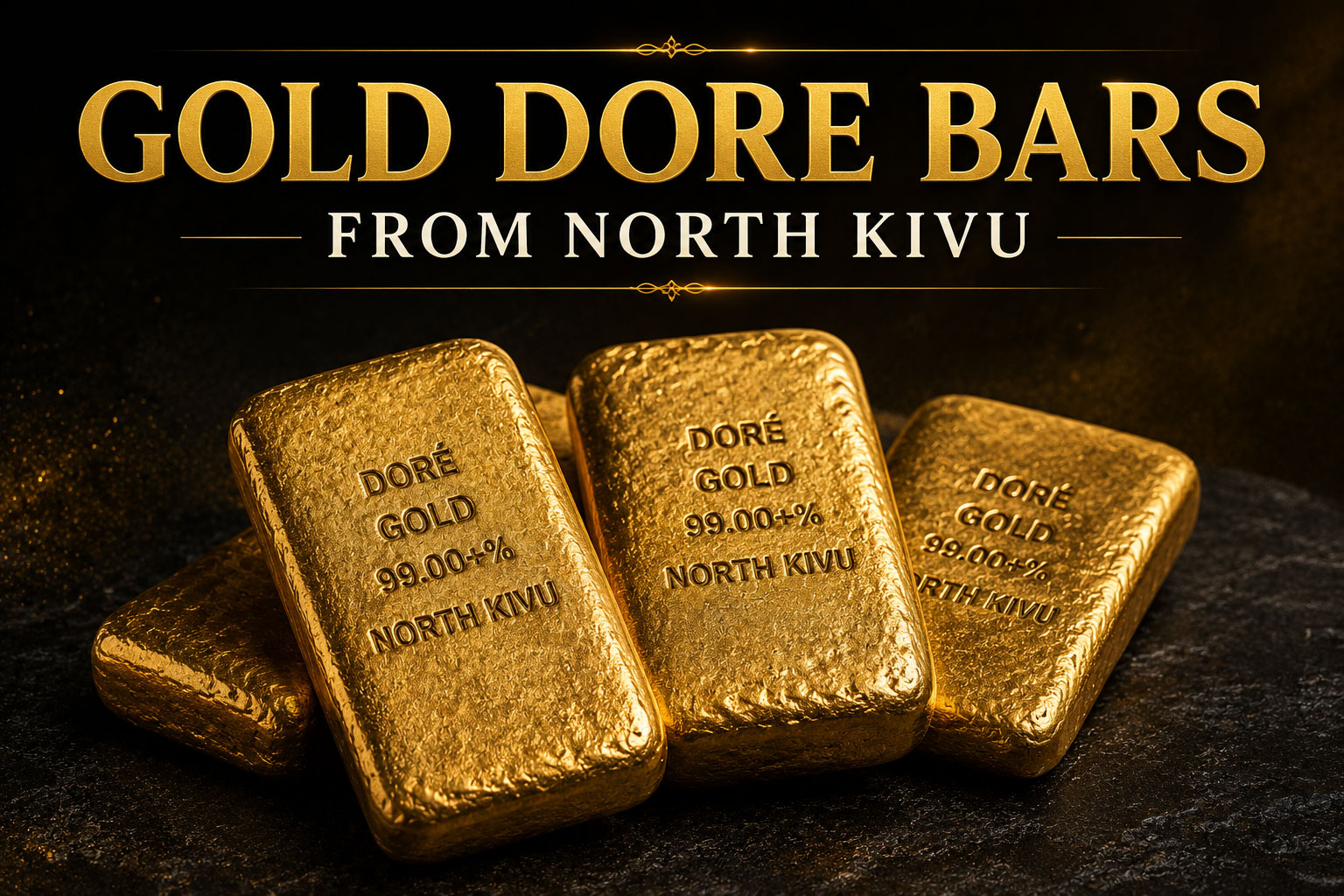
When a buyer or trading company purchases gold dore bars from North Kivu, Democratic Republic of Congo, the quoted purity of 85% to 96% is not just a quality figure. It is a commercial variable that directly determines processing costs, refinery margins, loss allowances, and the final settlement price paid to the seller.
Many buyers, particularly those new to artisanal and small-scale mining (ASM) supply chains in Central Africa, treat purity as a simple multiplier. In practice, it is far more complex. Understanding the mechanics of what happens at the smelting and refining stage is essential for any buyer, trading house, or end-user refinery that wants to accurately model costs and avoid unexpected losses.
This explainer breaks down exactly what dore purity means in practical refinery terms.
Gold dore is an unrefined alloy of gold and silver, sometimes containing trace amounts of copper, iron, lead, zinc, bismuth, and other base metals. It is produced at or near the mine site by melting down the gold concentrate or amalgam recovered during artisanal processing.
In North Kivu, artisanal miners work across a range of geological settings, from alluvial river deposits to hard-rock quartz veins. The resulting dore varies in composition depending on:
This is why North Kivu dore typically ranges from 85% to 96% gold, with the remainder being primarily silver and minor base metal impurities. A bar from an alluvial deposit near the Ulindi River may test at 91%, while a hard-rock bar from near Walikale may come in at 87% due to higher silver content in the ore.
The variation is not a defect. It is an inherent characteristic of artisanal dore production, and professional buyers and refineries are well-equipped to handle it. However, the purity point matters enormously in determining what the bar is worth.
When dore arrives at an accredited refinery, the processing sequence typically follows these stages:
The first step is fire assay or X-ray fluorescence (XRF) analysis. The refinery takes samples from multiple points in the consignment to determine the precise gold, silver, and impurity content. This assay result is the basis for the entire financial settlement.
It is important to note that the assay result at the refinery may differ from the seller's pre-shipment assay. Refineries apply their own analytical standards and will use their certified assay for settlement purposes.
The dore is melted in induction or gas-fired furnaces. During this stage, base metal impurities with lower melting and boiling points begin to volatilize or oxidize and are removed as slag. This process reduces the non-gold content of the material.
The resulting material is a more purified alloy, but it is still not .9999 fine gold. Further refining is required.
The refinery then uses one or a combination of:
For standard commercial dore in the 85-96% range, the Miller Process is typically used first, followed by Wohlwill electrolysis to achieve investment-grade purity.
Contact us for sourcing inquiries or technical questions about North Kivu dore specifications.
When we say a bar is 90% pure gold, we mean that in every 100 grams of dore, there are approximately 90 grams of gold and 10 grams of other material (silver, copper, base metals).
However, the refinery does not simply pay for 90% of the gold spot price. The calculation is more nuanced and involves several deductions. Understanding each deduction is critical.
| Parameter | 85% Purity Bar | 90% Purity Bar |
|---|---|---|
| Total bar weight | 1,000 g | 1,000 g |
| Gross gold content | 850 g | 900 g |
| Silver content (est.) | 120 g | 80 g |
| Base metal impurities | 30 g | 20 g |
| Net payable gold (after losses) | ~832 g | ~882 g |
| Note | Higher processing load | Standard refinery feed |
Loss factors are percentage deductions applied by the refinery to account for:
Loss factors typically increase as dore purity decreases. This is because lower-purity material contains more impurities that must be removed, requiring more intensive processing and generating more by-product streams in which gold can be mechanically or chemically trapped.
| Dore Purity Range | Typical Refinery Loss Factor | Effective Gold Recovery |
|---|---|---|
| 96% - 99% | 0.5% - 1.0% | 99.0% - 99.5% |
| 91% - 95% | 1.0% - 1.5% | 98.5% - 99.0% |
| 85% - 90% | 1.5% - 2.5% | 97.5% - 98.5% |
| Below 85% | 2.5% - 4.0%+ | 96.0% - 97.5% |
These figures are illustrative. Each refinery publishes its own treatment schedule. London Bullion Market Association (LBMA)-accredited refineries are required to maintain transparent and auditable loss accounting.
Critically, a buyer purchasing 85% dore and expecting to lose only 1% at the refinery will be financially surprised. The actual loss on a low-purity bar may be 2% or more of the gold content. On a large consignment, this difference can amount to tens of thousands of dollars.
Contact us for sourcing inquiries or technical questions about North Kivu dore specifications.
In addition to loss factors, refineries charge treatment fees (also called smelting and refining charges, or TC/RC). These are typically structured as:
Lower purity dore generates higher treatment charges in two ways. First, the refinery must process more impurity volume for the same amount of gold. Second, penalty charges for base metals (copper, lead, bismuth, zinc) are applied based on the impurity content revealed in the assay.
| Charge Component | 90% Purity Bar | 85% Purity Bar |
|---|---|---|
| Base refining charge | USD 1.50/troy oz | USD 1.50/troy oz |
| Base metal penalty (copper) | Nil | USD 0.40/troy oz |
| Complex feed surcharge | Nil | USD 0.30/troy oz |
| Total charge (approx.) | USD 1.50/troy oz | USD 2.20/troy oz |
For a consignment of 500 troy ounces, the difference in treatment charges between a 90% bar and an 85% bar could exceed USD 3,500 in this example. Multiplied across multiple shipments over a year, the financial impact is substantial.
The final settlement for a dore purchase is calculated as follows:
Step 1: Assay-certified gold content (grams or troy ounces)
Step 2: Apply the refinery loss factor to determine payable gold
Step 3: Apply the refinery outturn percentage (typically 99.0% to 99.5% for standard dore)
Step 4: Multiply payable gold by the agreed gold price (LBMA AM or PM fix, or spot)
Step 5: Deduct treatment and refining charges
Step 6: Deduct any applicable penalties for base metals or contaminants
Step 7: Net settlement = amount paid to seller (or amount payable to buyer if structured as a purchase)
| Item | Value |
|---|---|
| Total bar weight | 10,000 g (321.5 troy oz) |
| Gold content at 90% assay | 9,000 g (289.4 troy oz) |
| Less: 1.5% refinery loss | 133.5 g (4.3 troy oz) |
| Payable gold | 8,866.5 g (285.1 troy oz) |
| Gold price (LBMA PM fix example) | USD 2,400 per troy oz |
| Gross value | USD 684,240 |
| Less: Treatment charges (USD 1.50/oz) | USD 427.65 |
| Net settlement to seller | USD 683,812.35 |
Contact us for sourcing inquiries or technical questions about North Kivu dore specifications.
A point often missed in commercial negotiations is that silver present in dore is recoverable and commands a credit. Silver in North Kivu dore is typically present in concentrations of 3% to 12% depending on the ore source.
Refineries will assay the silver content and apply a silver outturn at a lower recovery rate than gold (typically 95% to 98% for silver). The resulting silver credit is calculated as:
Silver credit = payable silver (troy oz) x silver spot price x agreed percentage (usually 95% to 98%)
For a bar with 8% silver content by weight, the silver credit can partially offset higher treatment charges. Buyers should factor silver credit into their landed cost models, particularly for lower-purity dore where silver concentrations may be higher.
Understanding the mechanics above leads to several direct commercial implications for any buyer procuring from North Kivu:
Two bars, one at 90% and one at 85%, are not simply 5% apart in value. The 85% bar will incur higher loss factors, higher treatment charges, and potentially base metal penalties. The all-in cost differential may be 7% to 9% when fully modeled.
Ensure that the seller's pre-shipment assay uses a recognised methodology (fire assay is preferred over XRF for settlement purposes). Discrepancies between the field assay and refinery assay create settlement disputes and can erode margins
Every LBMA-accredited refinery publishes a fee schedule. Before committing to a purchase, model the refinery charges against the expected purity range of the consignment. Do not assume a single flat rate applies.
Many refineries apply minimum consignment charges. Small consignments of dore (below 5 kg gold equivalent) may face disproportionately high per-ounce costs due to fixed minimum charges. Buyers should aggregate shipments where operationally possible.
When contracting to buy North Kivu dore at an agreed purity range, include provisions for price adjustment if the assay result falls outside the agreed range. This protects both buyer and seller from unexpected financial outcomes.
Contact us for sourcing inquiries or technical questions about North Kivu dore specifications.
North Kivu is a conflict-affected region under the scope of the OECD Due Diligence Guidance for Responsible Supply Chains of Minerals from Conflict-Affected and High-Risk Areas (CAHRAs). Buyers sourcing from this region are required to conduct risk-based due diligence across their supply chain.
This compliance requirement has a direct bearing on refinery access. LBMA-accredited refineries and other responsible smelters will require:
Buyers who cannot provide adequate compliance documentation may find themselves limited to non-LBMA refineries, which may offer less favourable treatment terms or lower gold recovery rates.
At East Africa Plus Minerals, all mineral exports are handled with full compliance documentation, chain of custody records, and traceability reporting aligned with international due diligence standards. This ensures that buyers can present their refinery with complete documentation packages and access the best available treatment terms.
| Factor | 85% Purity | 90% Purity | 96% Purity |
|---|---|---|---|
| Gross gold content (per kg) | 850 g | 900 g | 960 g |
| Typical loss factor | 1.5% - 2.5% | 1.0% - 1.5% | 0.5% - 1.0% |
| Relative treatment charge | Higher | Standard | Lower |
| Silver credit potential | Higher | Moderate | Lower |
| Base metal penalties | More likely | Possible | Unlikely |
| Complexity for refinery | High | Medium | Low |
Gold dore purity is not a single-dimension variable. It is the entry point to a set of cascading financial calculations that determine the true economics of a dore purchase.
Buyers who understand the loss factor mechanics, treatment charge structures, and silver credit dynamics are in a far stronger position to evaluate offers, negotiate with refineries, and accurately project margins.
North Kivu dore in the 85–96% range is commercially viable and regularly processed by major refineries worldwide. The key is knowing exactly what you are paying for and how the refinery will account for every gram of metal in the bar.
East Africa Plus Minerals works with buyers and trading companies at every stage of the process, from pre-shipment assay and documentation through to refinery introduction and settlement support. We provide transparent, professionally documented consignments structured for smooth refinery processing and maximum commercial clarity.
Contact us for sourcing inquiries or technical questions about North Kivu dore specifications.